


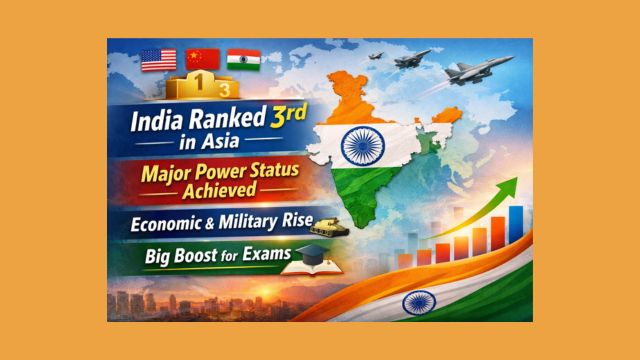
India Ranks 3rd in Asia Power Index 2025: A Major Milestone
Why This News Matters
India’s rise on the global stage is no longer just a talking point—it is now backed by data. In the Asia Power Index 2025, released by the Australia-based Lowy Institute, India has secured 3rd place overall, crossing the crucial 40-point threshold for the first time. This officially places India in the category of a “Major Power” in Asia, behind only the United States and China.
For students preparing for competitive exams, policymakers, and citizens alike, this ranking is a strong indicator of how India’s economic strength, military preparedness, and diplomatic outreach are reshaping power dynamics in the Indo-Pacific region.
What Is the Asia Power Index?
The Asia Power Index (API) is an annual assessment published by the Lowy Institute; a respected international policy think tank based in Australia.
Rather than focusing only on military or economic size, the index evaluates how effectively a country can shape its external environment.
Key Features of the Index
- Covers 27 countries and territories
- Uses 131 quantitative and qualitative indicators
- Assesses power across eight thematic areas
- Includes not just Asia, but also:
- The United States
- Russia
- Australia
- New Zealand
This makes the index one of the most comprehensive measures of influence in the Indo-Pacific region.
Asia Power Index 2025: Top 10 Countries
| Rank | Country | Category | Power Score |
| 1 | United States | Superpower | 80.4 |
| 2 | China | Superpower | 73.7 |
| 3 | India | Major Power | 40.0 |
| 4 | Japan | Middle Power | 38.8 |
| 5 | Russia | Middle Power | 32.1 |
| 6 | Australia | Middle Power | 31.8 |
| 7 | South Korea | Middle Power | 31.5 |
| 8 | Singapore | Middle Power | 26.8 |
| 9 | Indonesia | Middle Power | 22.4 |
| 10 | Malaysia | Middle Power | 20.5 |
India’s Historic Achievement in 2025
India’s overall power score of 40.0 is significant for two reasons:
- First time crossing 40 points, a benchmark used by the Lowy Institute to define a “Major Power”.
- India now stands clearly above traditional middle powers like Japan and Russia in overall influence.
This marks a structural shift in Asia’s power hierarchy—from a US-China dominated order to a three-tier system, with India firmly positioned just below the two superpowers.
ALSO READ – Experts believe that the Raj Kumar Goyal CIC appointment in 2025 will play a key role in strengthening India’s Right to Information system by ensuring timely information delivery and institutional transparency.
How the Asia Power Index Measures Power
The index evaluates countries across eight pillars:
- Economic Capability – Size, growth, and structure of the economy
- Military Capability – Defence spending, force structure, readiness
- Resilience – Ability to withstand economic and political shocks
- Future Resources – Demographics, innovation, education, technology
- Economic Relationships – Trade, investment, and supply chains
- Defence Networks – Military alliances and security partnerships
- Diplomatic Influence – Global and regional engagement
- Cultural Influence – Soft power, media, education, tourism
This multi-dimensional approach ensures that power is seen as comprehensive influence, not just raw strength.
Key Factors Behind India’s Rise
-
Strong Economic Performance
India recorded a major improvement in economic capability in 2025, overtaking Japan to rank third globally in this category.
Reasons behind the rise:
- Sustained post-pandemic growth
- Rising foreign direct investment (FDI)
- Expanding manufacturing and services sectors
- Deeper integration into global supply chains
India’s large domestic market and reform-driven growth model continue to strengthen its economic base.
-
Improved Military Capability
India’s defence preparedness and operational experience also contributed to its higher ranking.
- Operation Sindoor (May 2025) highlighted:
- Improved operational coordination
- Better combat readiness
- Enhanced confidence in defence forces
Regular military exercises, modernization efforts, and indigenous defence production have positively influenced India’s military metrics.
-
Advantage in Future Resources
One of India’s strongest areas is Future Resources, which reflect long-term potential.
Key strengths include:
- A young and growing population
- Expanding technology and startup ecosystem
- Rising investment in innovation and digital infrastructure
These factors suggest that India’s influence is not temporary but structurally sustainable.
-
Diplomatic and Strategic Partnerships
India’s active diplomacy has played a crucial role in its rise.
- Strong engagement with:
- Quad (India, US, Japan, Australia)
- G20 (India hosted the summit recently)
- Focus on:
- Economic diplomacy
- Regional connectivity
- Strategic autonomy
India is increasingly seen as a balancing power in the Indo-Pacific.
Where Does India Still Lag?
Despite its achievements, the index also highlights areas needing improvement.
Defence Networks
- India ranks lower in defence alliances compared to countries like Japan or Australia.
- Unlike NATO-style alliances, India prefers issue-based partnerships, which can limit formal security influence.
Power Gap
- The gap between potential resources and actual influence suggests scope for:
- Deeper diplomatic outreach
- Stronger institutional presence abroad
These gaps represent opportunities, not weaknesses.
Broader Trends from Asia Power Index 2025
Continued US–China Dominance
- The United States remains the most powerful country in the Indo-Pacific.
- China continues its strong second position, though the gap with the US has stabilized.
India as a Distinct Third Pole
- India is no longer grouped with middle powers.
- It is now seen as a standalone major power with regional leadership potential.
Why This Is Important for Competitive Exams
This topic is highly relevant for:
- Relevant for UPSC Civil Services Examination (Prelims and Mains – General Studies Paper II & III)
- State PCS exams
- SSC, Banking, and Defence exams
Possible Exam Angles
- Role of think tanks like the Lowy Institute
- India’s position in Indo-Pacific geopolitics
- Difference between “superpower,” “major power,” and “middle power”
- Soft power vs hard power
📌 Trivia / Fun Fact
Did you know?
The Asia Power Index is often referred to as the “power barometer” of the Indo-Pacific, and its findings are closely studied by governments, diplomats, and defence analysts worldwide.
Frequently Asked Questions (FAQs)
Q1. What is the Asia Power Index?
It is an annual ranking by the Lowy Institute measuring how countries influence the Indo-Pacific region.
Q2. Which country topped the Asia Power Index 2025?
The United States ranked first with a score of 80.4.
Q3. Why is India’s 3rd rank significant?
India crossed the 40-point mark for the first time, entering the “Major Power” category.
Q4. How many countries are ranked in the index?
A total of 27 countries and territories are assessed.
Q5. What are India’s strongest areas in the index?
Economic capability, future resources, and diplomatic influence.
Q6. Where does India need improvement?
Defence networks and translating potential power into actual influence.
A Thoughtful Conclusion
India’s third-place ranking in the Asia Power Index 2025 is more than a numerical achievement—it reflects decades of gradual progress in economic reform, strategic thinking, and global engagement. While challenges remain, India’s elevation to major power status signals growing confidence from the international community in its long-term role.
For students and citizens alike, this moment is a reminder that national strength is built not overnight, but through sustained effort, resilience, and vision. As Asia’s power balance evolves, India is no longer just participating—it is shaping the conversation.