


Raj Kumar Goyal Appointed Chief Information Commissioner: Key Appointments Shaping Governance, Politics and Media
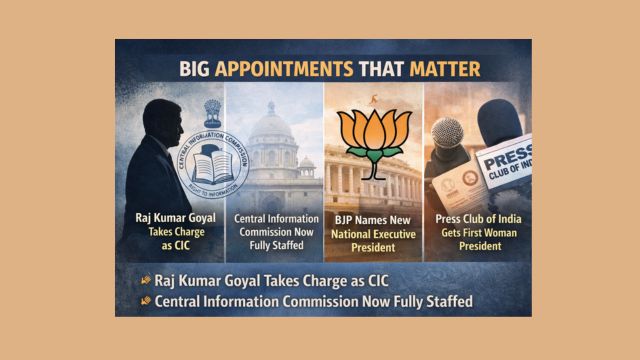
The appointment of a new Chief Information Commissioner (CIC) is not just a routine bureaucratic change—it directly affects how transparently the government functions and how effectively citizens can exercise their Right to Information (RTI). In December 2025, several important appointments across governance, politics, and media made headlines, with former IAS officer Raj Kumar Goyal taking charge as the new CIC, the BJP appointing Nitin Naveen to a key organizational role, and the Press Club of India electing its first-ever woman president. Together, these developments reflect shifting dynamics in accountability, political leadership, and media representation in India.
Former IAS Officer Raj Kumar Goyal Assumes Charge as Chief Information Commissioner.
On December 15, 2025, President Droupadi Murmu administered the oath of office to Raj Kumar Goyal as the Chief Information Commissioner (CIC) of the Central Information Commission. With this, Goyal succeeded Heeralal Samariya, whose tenure ended on September 13, 2025, leaving the top post vacant for nearly three months.
The appointment was based on the recommendation of a three-member selection committee comprising:
- Prime Minister Narendra Modi (Chairperson),
- Union Home Minister Amit Shah, and
- Rahul Gandhi is serving as the Opposition Leader in the Lok Sabha.
Notably, Rahul Gandhi recorded a dissent during the committee meeting on December 10, stating that the proposed names lacked adequate diversity—an issue that has increasingly become part of public discourse around institutional appointments.
Who Is Raj Kumar Goyal? Career and Administrative Background
Raj Kumar Goyal is a 1990-batch retired IAS officer of the AGMUT cadre (Arunachal Pradesh–Goa–Mizoram–Union Territories). Originally part of the Jammu and Kashmir cadre, his service profile evolved after Jammu and Kashmir became a Union Territory in 2019.
Key Career Highlights
- Retired on August 31, 2025, as Secretary, Department of Justice, Ministry of Law and Justice
- Held the position of Secretary for Border Management in the Ministry of Home Affairs.
- Held senior positions in the Ministry of Home Affairs and the Ministry of External Affairs
- Worked extensively in sensitive administrative areas, including the erstwhile state of Jammu and Kashmir
His experience in justice administration and internal security is seen as particularly relevant for leading an institution that balances transparency with national and administrative sensitivities.
A Full Central Information Commission After Nine Years
Soon after taking oath, Raj Kumar Goyal administered the oath of office to eight new Information Commissioners, in the presence of the two incumbent commissioners:
- Anandi Ramalingam
- Vinod Kumar Tiwari
Newly Appointed Information Commissioners
- Surendra Singh Meena – 1993-batch IAS officer, Jharkhand cadre
- Ashutosh Chaturvedi – Senior journalist; former Editor-in-Chief, Prabhat Khabar
- Swagat Das – Former IPS officer (1987 batch), ex-Secretary (Security), Cabinet Secretariat
- Sudha Rani Relangi – Retired Indian Legal Service officer; key contributor to drafting the RTI Act
- P. R. Ramesh – Senior journalist; former Managing Editor, Open magazine
- Khushwant Singh Sethi – 1990-batch Indian Forest Service officer, Tripura cadre
- Jaya Varma Sinha – Former Chairperson and CEO, Railway Board
- Sanjeev Kumar Jindal – 1989-batch Central Secretariat Service officer, former Additional Secretary, MHA
With these appointments, the Central Information Commission now has its full sanctioned strength for the first time in nine years, a development welcomed by transparency activists given the long pendency of RTI appeals.
Also Read – What began as a decade-old investigation finally reached a turning point with the arrest of an international wildlife trafficker in Sikkim under an Interpol Red Notice.
What Is the Central Information Commission?
The Central Information Commission (CIC) is a statutory body, not a constitutional one.
Key Facts
- Established: Under the Right to Information Act, 2005
- Composition:
- One Chief Information Commissioner
- Up to 10 Information Commissioners
- Appointment: By the President of India on the recommendation of a committee comprising:
- Prime Minister
- Leader of Opposition in the Lok Sabha
- A Union Cabinet Minister nominated by the PM
Eligibility & Disqualifications
- Eminent persons with experience in:
- Law, journalism, science, technology, governance, social service, or management
- Must not be:
- MPs or MLAs
- Holders of any office of profit
- No political affiliation or business engagement
- No reappointment allowed
Powers and Functions
- Summon witnesses and examine them under oath
- Call for public records and inspect documents
- Ensure effective implementation of the RTI Act
- Adjudicate RTI appeals and complaints related to Central public authorities
Why This CIC Appointment Matters
The Central Information Commission plays a crucial role in:
- Protecting citizens’ right to information
- Enhancing government accountability
- Reducing opacity in public administration
With thousands of RTI appeals pending annually, a fully staffed commission is essential for timely justice. Raj Kumar Goyal’s appointment, along with eight new commissioners, is expected to improve disposal rates and restore institutional efficiency.
BJP Appoints Bihar Minister Nitin Naveen as National Executive President
In another major appointment, the Bharatiya Janata Party (BJP) announced Nitin Naveen, Bihar’s Public Works Department (PWD) minister, as its National Executive President on December 14, 2025.
About Nitin Naveen
- MLA from Bankipur, Patna
- Belongs to the Kayastha community
- Son of late BJP leader Nabin Kishore Sinha
- Began political career through ABVP student politics
- First elected to the Bihar Assembly in 2010
He replaces J. P. Nadda and is seen as a leader with strong organisational roots. The announcement coincided with the BJP naming Pankaj Chaudhary as the new Uttar Pradesh state president, signalling organisational reshuffling ahead of future elections.
Press Club of India Elects First Woman President
In a historic moment for Indian media, senior journalist Sangeeta Barua Pisharoty was elected as the first woman President of the Press Club of India.
Election Highlights
- Elections held on December 13, 2025
- Results announced on December 14
- Her panel won all posts by a 21–0 margin
New Office Bearers
- President: Sangeeta Barua Pisharoty
- Vice President: Jatin Gandhi
- General Secretary: Afzal Imam
- Joint Secretary: P. R. Sunil
- Treasurer: Aditi Rajput
Established in 1958, the Press Club of India is a powerful professional body representing journalists. This election is widely seen as a step towards greater gender representation in media leadership.
Why This News Is Important for Competitive Exams
This combined news package is highly relevant for:
- UPSC Civil Services (Polity, Governance, Ethics, Current Affairs)
- State PCS exams
- SSC, Banking, Railways, Defence exams
Exam-Relevant Themes
- RTI Act, 2005
- Statutory vs constitutional bodies
- Appointment procedures and checks & balances
- Role of media institutions in democracy
- Political party organisation
Trivia / Fun Fact Box
📌 Did you know?
The Central Information Commission was once described by the Supreme Court as a “pillar of transparency” that strengthens participatory democracy by empowering citizens with information.
Frequently Asked Questions (FAQs)
Q1. Who appoints the Chief Information Commissioner?
The President of India appoints the CIC based on recommendations of a committee led by the Prime Minister.
Q2. Is the Central Information Commission a constitutional body?
No, it is a statutory body established under the RTI Act, 2005.
Q3. How many Information Commissioners can the CIC have?
Up to 10 Information Commissioners, in addition to the Chief Information Commissioner.
Q4. Why was the CIC post vacant in 2025?
The post became vacant after Heeralal Samariya’s tenure ended in September 2025.
Q5. Who is the first woman President of the Press Club of India?
Sangeeta Barua Pisharoty.
Q6. What role does the CIC play in governance?
It ensures effective implementation of the RTI Act and protects citizens’ right to information.
Conclusion
The swearing-in of Raj Kumar Goyal as Chief Information Commissioner, the completion of the Central Information Commission after nearly a decade, key organisational changes within the BJP, and a historic leadership shift at the Press Club of India together mark an important moment in India’s institutional life. These developments highlight how governance, politics, and media continuously evolve to meet democratic expectations.
For students and aspirants, this is a classic example of how current affairs intersect with constitutional values, transparency, and democratic accountability—making it essential reading not just for exams, but for understanding how India’s institutions function in practice.