
Exclusive Insight: How India Achieved a Major Wildlife Crime Breakthrough
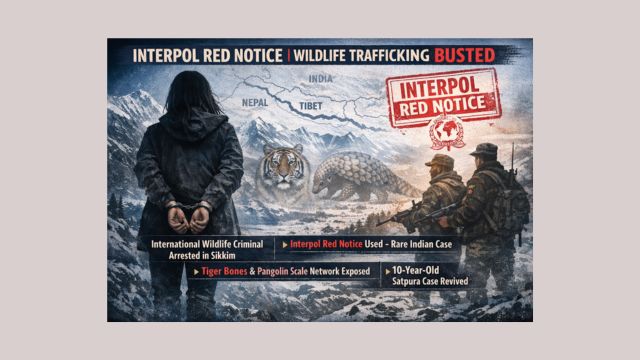
The arrest of an international wildlife trafficker in the icy mountains of North Sikkim has become one of India’s most significant breakthroughs against organized wildlife crime. In a rare and high-risk operation, the Madhya Pradesh State Tiger Strike Force (STSF), in collaboration with the Wildlife Crime Control Bureau (WCCB), successfully captured Yangchen Lachungpa, a fugitive wanted under an INTERPOL Red Notice.
This action has revived a decade-old case and opened a crucial window into one of the biggest wildlife trafficking networks in South Asia. For students preparing for competitive exams, this case is important because it connects wildlife laws, INTERPOL functions, environmental governance, and law-enforcement coordination across states and countries.
A High-Stakes Arrest in the Himalayas
On 2 December 2025, a specialized team from Madhya Pradesh reached Lachung, a remote Himalayan village near the India–China border. After months of surveillance, intelligence gathering, and close coordination with local authorities, they arrested 43-year-old Yangchen Lachungpa, who was considered a key facilitator in the international trafficking of tiger parts, pangolin scales, and other endangered wildlife products.
The operation was conducted in challenging conditions:
- Harsh winter and sub-zero temperatures
- Weak phone networks
- Local resistance and security concerns
- The need to keep public sentiment calm
- Remote terrain and sensitive border areas
Authorities described the arrest as being carried out in “movie-style conditions,” involving decoy teams, silent movements, and sudden pursuit. During the operation, Yangchen attempted to destroy two mobile phones and a coded diary containing names, routes, and possible financial links of the trafficking network.
Why This Arrest Is Considered Historic
This is one of the rare cases in India where a wildlife criminal has been arrested following the issuance of an Interpol Red Notice.
- The Red Notice, requested by WCCB as India’s INTERPOL contact office, was issued on 2 October 2025.
- Within two months, authorities traced and arrested the fugitive.
- Such notices are usually issued only in serious transnational crimes.
After the arrest, Yangchen was taken to Gangtok for a mandatory medical examination and produced before the local court on 3 December 2025.
Her bail plea was rejected, and she was placed under transit remand to Madhya Pradesh, where further proceedings are underway in Narmadapuram.
Background: The 2015 Wildlife Crime Case
This breakthrough is linked to a case registered nearly a decade earlier.
- Date of Case Registration: 13 July 2015
- Location: Kamti Range, Satpura Tiger Reserve, Hoshangabad (now Narmadapuram), Madhya Pradesh
Forest officials, during patrol, discovered:
- 4 pieces of tiger bones
- 1.5 kg of pangolin scales
- Tiger skin
- Materials used for extracting tiger bone oil
These items indicated a highly organized hunting and trafficking network dealing in parts of endangered species.
In late 2015, investigators arrested a key accused, Jai Tamang, whose statements pointed to Yangchen as the buyer and facilitator.
By 2022, 27 out of 36 accused had been convicted by a Narmadapuram court.
However, Yangchen, one of the central links, remained absconding for years.
A Look into the Trafficking Network
Investigations over the years revealed that Yangchen played a significant role in a transnational criminal network.
Alleged Operations Included:
- Trafficking tiger parts, pangolin scales, red sanders, and other contraband
- Maintaining routes across India, Nepal, Tibet, and Bhutan
- Managing multiple hideouts and contacts
- Operating from Lachung, Gangtok, Siliguri, Delhi, Kolkata, Kanpur, Itarsi, and Hoshangabad
International Seizures Linked to the Network
- In 2015, Ethiopian authorities seized eight tiger hides, three suspected to have originated from Satpura.
- In 2013, authorities in Nepal recovered five tiger skins and seven sacks of bones that were reportedly being transported illegally toward the Tibet region.
Financial Clues
Bank statements of associates showed suspicious transactions over ₹65 lakh in less than seven months, hinting at a powerful supply chain.
With Yangchen’s arrest, investigators expect fresh leads on:
- Buyers abroad
- Poaching syndicates
- Wildlife stockpiles
- Money movement routes
- Missing links in old seizure cases
Wildlife Crime Control Bureau (WCCB): Key Facts for Exams
WCCB played a major role in obtaining the Interpol Red Notice and coordinating the case.
About WCCB
- Established: 6 June 2007
- Ministry: Environment, Forest and Climate Change
- Nature: Statutory body under the Wildlife (Protection) Amendment Act, 2006
- Headquarters: New Delhi
Its Role Includes:
- Collecting and sharing intelligence on wildlife crimes
- Coordinating between agencies
- Assisting state forest departments
- Working with INTERPOL under CITES (Convention on International Trade in Endangered Species)
WCCB Offices
- Regional Offices: Delhi, Mumbai, Chennai, Kolkata, Jabalpur
- Sub-Regional Offices: Guwahati, Amritsar, Kochi
- Border Units: Ramanathapuram, Gorakhpur, Motihari, Nathula, Moreh
Understanding INTERPOL: Important for GS and GK
INTERPOL is the world’s largest international police cooperation organization, with 195 member countries.
Brief History
- 1914: First idea of international police cooperation (Monaco)
- 1923: ICPC formed in Vienna
- 1956: Name changed to INTERPOL
- 1989: Headquarters shifted to Lyon, France
- Today: Helps countries share crime-related information
INTERPOL Notices (Color-Coded)
- Red: Request to locate and arrest fugitives
- Blue: Information gathering
- Yellow: Missing persons
- Black: Unidentified bodies
- Orange: Public safety threats
- Purple: Criminal methods
- Silver: Criminal assets
Why This News Matters for Competitive Exams
This topic is relevant for:
- UPSC (Environment, Internal Security, International Relations)
- State PCS
- SSC & Railways (General Awareness)
- Defence exams
- Banking exams (current affairs)
Key Concepts in This Case:
- Wildlife (Protection) Act, 1972
- CITES
- Interpol Red Notices
- Powers of WCCB
- Coordination between states
- Border policing in the Himalayas
- Transnational criminal networks
Aspiring candidates must note how different agencies work together when a crime crosses borders or involves international networks.
Trivia / Fun Fact Box
Did you know?
Pangolins are the world’s most trafficked mammals. Their scales — made of keratin, the same material as human nails — are illegally sold despite zero medicinal value under modern science.
FAQs
- What is an Interpol Red Notice?
A Red Notice is a request to international law enforcement agencies to locate and arrest a fugitive pending extradition or legal action.
- Why was Yangchen Lachungpa wanted?
She was allegedly a key link in a wildlife trafficking network dealing in tiger parts, pangolin scales, and other endangered species.
- Which agency obtained the Red Notice?
The Wildlife Crime Control Bureau (WCCB), India’s Interpol contact office for wildlife cases.
- Where was she arrested?
She was arrested in Lachung, North Sikkim, near the India–China border.
- What happens after a transit remand?
The accused is legally allowed to be transferred from one state to another for further proceedings.
- How old is the original case?
It dates back to 2015, when tiger bones and pangolin scales were seized from Satpura Tiger Reserve.
- Why is this arrest significant?
Because wildlife criminals are rarely caught after a Red Notice, and few such operations succeed in remote, sensitive border areas.
If you want to learn exactly why the new Tata Sierra 2025 is a powerful upgrade, check out this detailed review article about the new Tata Sierra upgrade for 2025 buyers.
Conclusion
The arrest of Yangchen Lachungpa is not just a law-enforcement success—it is a reminder of the serious threats faced by India’s wildlife. The coordinated efforts of multiple agencies, harsh terrain, and international cooperation highlight the determination required to protect endangered species.
For exam aspirants, this case is a powerful example of how environmental protection, intelligence operations, and international policing come together.
As India continues strengthening its wildlife protection network, operations like this offer hope that even the most hidden trafficking chains can eventually be dismantled.